Vendor Portal Management
A Financial Control Framework for Accounts Receivable
This resource center outlines the financial control framework, operational processes, and best practices used by leading finance teams to manage vendor portals effectively.
operational insights
Vendor portal management has become a critical control point in modern Accounts Receivable operations as more enterprise customers require invoices to be submitted and managed through supplier portals. Organizations that treat vendor portal management as a structured financial control process can reduce invoice delays and improve payment predictability.
- Vendor portals frequently introduce hidden delays when invoices are rejected, disputed, or routed through complex approval workflows.
- Finance teams that actively monitor portal acceptance and approval status reduce payment cycle times and improve working capital visibility.
- Effective vendor portal management requires structured processes for dispute resolution, remittance tracking, and reconciliation.
- Organizations that implement standardized portal controls improve invoice acceptance rates and reduce administrative effort across the AR team.
ON THIS PAGE
Vendor Portal Financial Control Framework
The Vendor Portal Financial Control Framework defines eight operational controls used by finance teams to manage supplier portal billing, maintain invoice acceptance, and improve payment visibility.
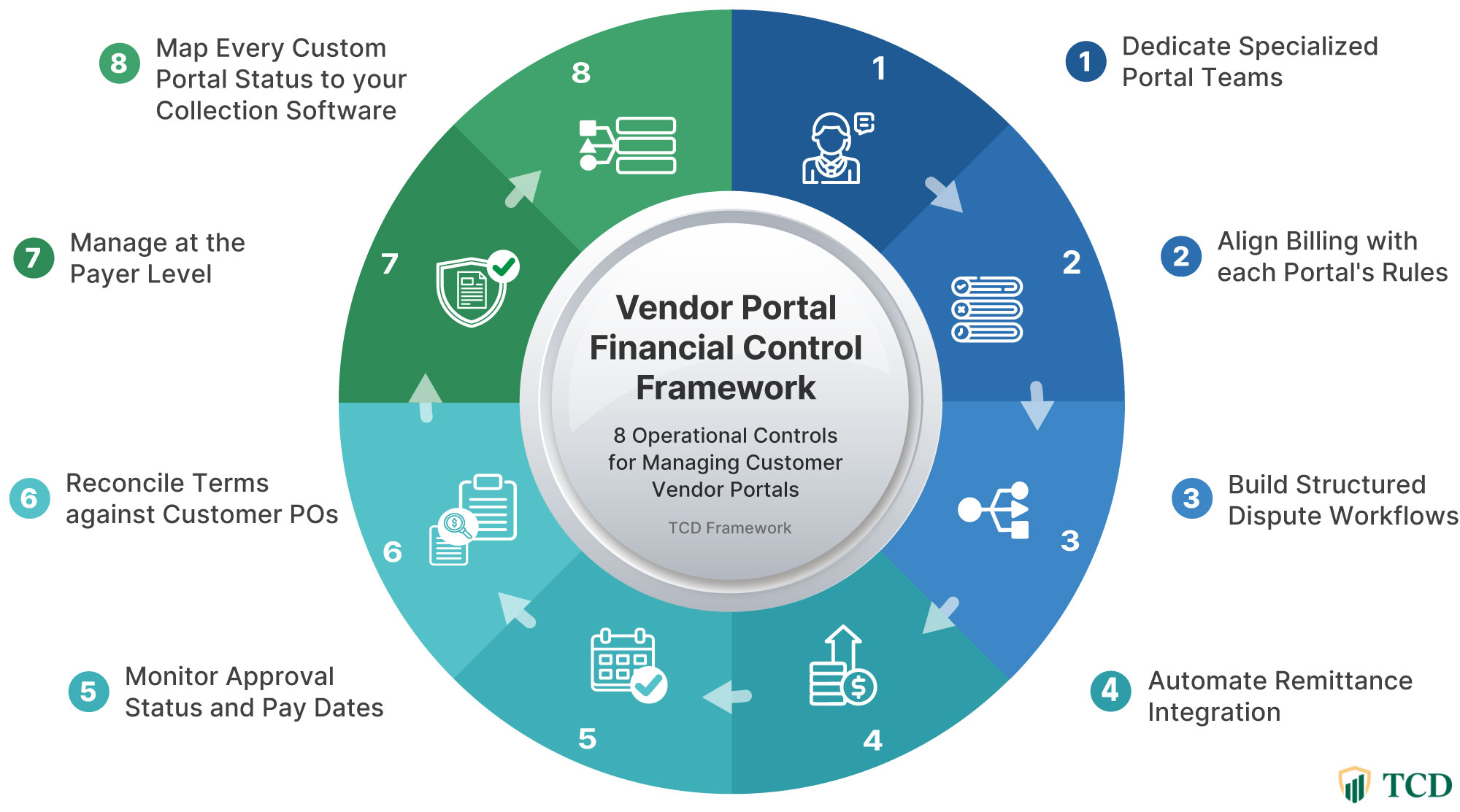
Effective vendor portal management requires coordinated processes across invoice submission, approval monitoring, dispute management, and payment reconciliation.
Finance teams that implement structured controls typically focus on five operational areas:
Portal Coverage
Identify which customers require vendor portal submission and maintain a centralized inventory of portals used across the customer base.
Invoice Acceptance Monitoring
Track invoice submission status and confirm acceptance within each portal to prevent unnoticed rejections or processing delays.
Dispute and Exception Resolution
Establish defined workflows for resolving rejected invoices, documentation issues, and approval delays within the portal environment.
Remittance and Payment Visibility
Capture remittance details and match portal payments to ERP records to maintain accurate receivables reconciliation.
Performance Monitoring
Measure portal-driven payment delays and identify process improvements that increase payment velocity.
Why Vendor Portal Management Matters for Finance Teams
Vendor portals often introduce hidden friction into the receivables process.
Without structured oversight, organizations commonly experience:
- Delayed invoice approvals
- Rejected invoices that go unnoticed
- Disputes caused by incomplete documentation
- Missing or unclear remittance data
- Extended payment cycles
These issues can reduce working capital predictability and increase administrative effort for AR teams.
Organizations that actively manage vendor portals as part of the AR process typically see improvements in:
- Invoice acceptance rates
- Dispute resolution speed
- Payment cycle time
- Cash flow predictability
Vendor Portal Management Best Practices
Leading finance teams implement structured processes to manage vendor portals consistently across customers.
Key best practices include:
- Maintaining a centralized portal inventory
- Validating invoice acceptance immediately after submission
- Establishing formal dispute resolution workflows
- Capturing remittance information directly from portals
- Reconciling portal payments with ERP receivables records
These operational practices help ensure that portal requirements do not disrupt receivables performance.
Technology and Automation in Vendor Portal Management
As the number of vendor portals increases, manual management becomes difficult to scale.
Finance teams increasingly rely on technology to:
- Monitor invoice submission and approval status across portals
- Capture remittance data automatically
- Reconcile payments with ERP records
- Identify approval delays or exceptions
- Maintain visibility across multiple customer portals
Automation helps reduce administrative effort while improving payment tracking and forecasting accuracy.
Vendor Portal Management Resources
Explore additional insights and guidance on managing vendor portals in modern AR operations.
Vendor Portal Management Best Practices
Operational processes used by leading finance teams.
Vendor Portal Financial Control Framework
A structured model for managing portal-based receivables.
Additional insights will continue to be added to this resource center.
Vendor Portal Management FAQ
Vendor portal management is the structured process of submitting, validating, monitoring, and reconciling invoices within customer vendor portals. Many enterprise customers require suppliers to submit invoices through procurement or supplier portals rather than traditional billing channels. Effective vendor portal management ensures invoices are submitted correctly, accepted by the customer system, approved in a timely manner, and ultimately reconciled against payments.
Finance teams that actively manage vendor portals can significantly reduce invoice delays, prevent avoidable disputes, and improve visibility into payment timing.
Vendor portal management matters because customer portals often introduce operational complexity into the billing process. Each portal may have unique requirements for invoice formatting, purchase order matching, documentation, and submission procedures. When these requirements are not managed consistently, invoices can be rejected, delayed, or routed incorrectly for approval.
By applying structured controls to vendor portal processes, finance teams can improve invoice acceptance rates, reduce administrative effort, and gain clearer insight into approval timelines and expected payment dates.
Effective vendor portal management relies on several operational controls that help ensure invoices are submitted correctly and payments are reconciled accurately. These controls typically include dedicated portal management resources, alignment of billing practices with customer portal requirements, immediate validation of invoice acceptance, structured dispute resolution workflows, automated remittance integration, approval status monitoring, reconciliation against customer purchase orders, and reconciliation at the payer level.
Together, these controls form the operational foundation of the Vendor Portal Financial Control Framework.
Vendor portal management improves cash flow by increasing the likelihood that invoices are accepted and approved without delay. When finance teams actively validate invoice acceptance, monitor approval workflows, and reconcile remittance information quickly, they reduce the number of invoices that become stalled within customer portals.
Improved visibility into portal approval status also allows finance teams to identify issues earlier, resolve disputes faster, and maintain more predictable payment cycles.
As organizations grow and customers adopt multiple procurement portals, managing these workflows manually becomes increasingly difficult. Technology designed for vendor portal management, such as SMART, can automate submission tracking, monitor invoice acceptance, capture remittance data, and support reconciliation across multiple customer portals.
These solutions help finance teams scale vendor portal operations while improving billing accuracy, operational efficiency, and payment visibility.
Companies often face operational challenges when managing vendor portals because each customer portal may have different requirements for invoice submission, purchase order matching, documentation, and approval workflows. Without a structured process, invoices may be rejected, delayed, or routed incorrectly within the customer’s procurement system.
Organizations that implement formal vendor portal management practices can reduce these issues by ensuring invoices meet portal requirements, monitoring submission acceptance, and proactively addressing disputes or approval delays.
The vendor portal management process typically includes several operational steps that ensure invoices are submitted, accepted, approved, and reconciled correctly. These steps often include validating billing information before submission, confirming invoice acceptance within the portal, monitoring approval workflows, managing disputes when they occur, and reconciling remittance information once payment is received.
A structured process helps finance teams maintain visibility into invoice status and reduces the likelihood of delays caused by portal submission errors or missing documentation.
Yes. Many organizations are beginning to automate portions of the vendor portal management process using specialized technology designed to track portal submissions, monitor approval status, and integrate remittance information into accounts receivable systems.
Automation can reduce the manual effort required to manage multiple customer portals while improving invoice accuracy, approval visibility, and reconciliation efficiency.
Managing vendor portals manually becomes increasingly complex as organizations grow and customers adopt different procurement platforms. Modern finance teams increasingly rely on specialized technology to automate portal submissions, monitor invoice acceptance, track approval workflows, and reconcile payments across multiple portals.
Solutions designed specifically for vendor portal management can significantly reduce operational workload while improving invoice acceptance and payment predictability.
Technology That Scales Vendor Portal Management
Managing invoices across multiple vendor portals creates hidden delays in the receivables process.
TCD’s SMART Portal Management Tool helps finance teams automate and control the vendor portal lifecycle, including:
- Invoice submission tracking
- Portal reconciliations
- Billing compliance validation
- Dispute workflow management
- Payment forecasting
Result: stronger financial controls, reduced manual effort, improved billing service, and faster cash flow.


includes prebuilt integrations for vendor portals
















*additional portals and custom integrations available.
Vendor Portal Management FAQ
Vendor portal management is the structured process of submitting, validating, monitoring, and reconciling invoices within customer vendor portals. Many enterprise customers require suppliers to submit invoices through procurement or supplier portals rather than traditional billing channels. Effective vendor portal management ensures invoices are submitted correctly, accepted by the customer system, approved in a timely manner, and ultimately reconciled against payments.
Finance teams that actively manage vendor portals can significantly reduce invoice delays, prevent avoidable disputes, and improve visibility into payment timing.
Vendor portal management matters because customer portals often introduce operational complexity into the billing process. Each portal may have unique requirements for invoice formatting, purchase order matching, documentation, and submission procedures. When these requirements are not managed consistently, invoices can be rejected, delayed, or routed incorrectly for approval.
By applying structured controls to vendor portal processes, finance teams can improve invoice acceptance rates, reduce administrative effort, and gain clearer insight into approval timelines and expected payment dates.
Effective vendor portal management relies on several operational controls that help ensure invoices are submitted correctly and payments are reconciled accurately. These controls typically include dedicated portal management resources, alignment of billing practices with customer portal requirements, immediate validation of invoice acceptance, structured dispute resolution workflows, automated remittance integration, approval status monitoring, reconciliation against customer purchase orders, and reconciliation at the payer level.
Together, these controls form the operational foundation of the Vendor Portal Financial Control Framework.
Vendor portal management improves cash flow by increasing the likelihood that invoices are accepted and approved without delay. When finance teams actively validate invoice acceptance, monitor approval workflows, and reconcile remittance information quickly, they reduce the number of invoices that become stalled within customer portals.
Improved visibility into portal approval status also allows finance teams to identify issues earlier, resolve disputes faster, and maintain more predictable payment cycles.
As organizations grow and customers adopt multiple procurement portals, managing these workflows manually becomes increasingly difficult. Technology designed for vendor portal management, such as SMART, can automate submission tracking, monitor invoice acceptance, capture remittance data, and support reconciliation across multiple customer portals.
These solutions help finance teams scale vendor portal operations while improving billing accuracy, operational efficiency, and payment visibility.
Companies often face operational challenges when managing vendor portals because each customer portal may have different requirements for invoice submission, purchase order matching, documentation, and approval workflows. Without a structured process, invoices may be rejected, delayed, or routed incorrectly within the customer’s procurement system.
Organizations that implement formal vendor portal management practices can reduce these issues by ensuring invoices meet portal requirements, monitoring submission acceptance, and proactively addressing disputes or approval delays.
The vendor portal management process typically includes several operational steps that ensure invoices are submitted, accepted, approved, and reconciled correctly. These steps often include validating billing information before submission, confirming invoice acceptance within the portal, monitoring approval workflows, managing disputes when they occur, and reconciling remittance information once payment is received.
A structured process helps finance teams maintain visibility into invoice status and reduces the likelihood of delays caused by portal submission errors or missing documentation.
Yes. Many organizations are beginning to automate portions of the vendor portal management process using specialized technology designed to track portal submissions, monitor approval status, and integrate remittance information into accounts receivable systems.
Automation can reduce the manual effort required to manage multiple customer portals while improving invoice accuracy, approval visibility, and reconciliation efficiency.
All product names, logos, and brands are property of their respective owners. All company, product and service names used on this website are for identification purposes only. Use of these names, logos, and brands does not imply endorsement.
TCD is an independent provider of Accounts Receivable solutions and is not affiliated with or endorsed by the companies referenced on this page unless otherwise stated.